For Your Kit
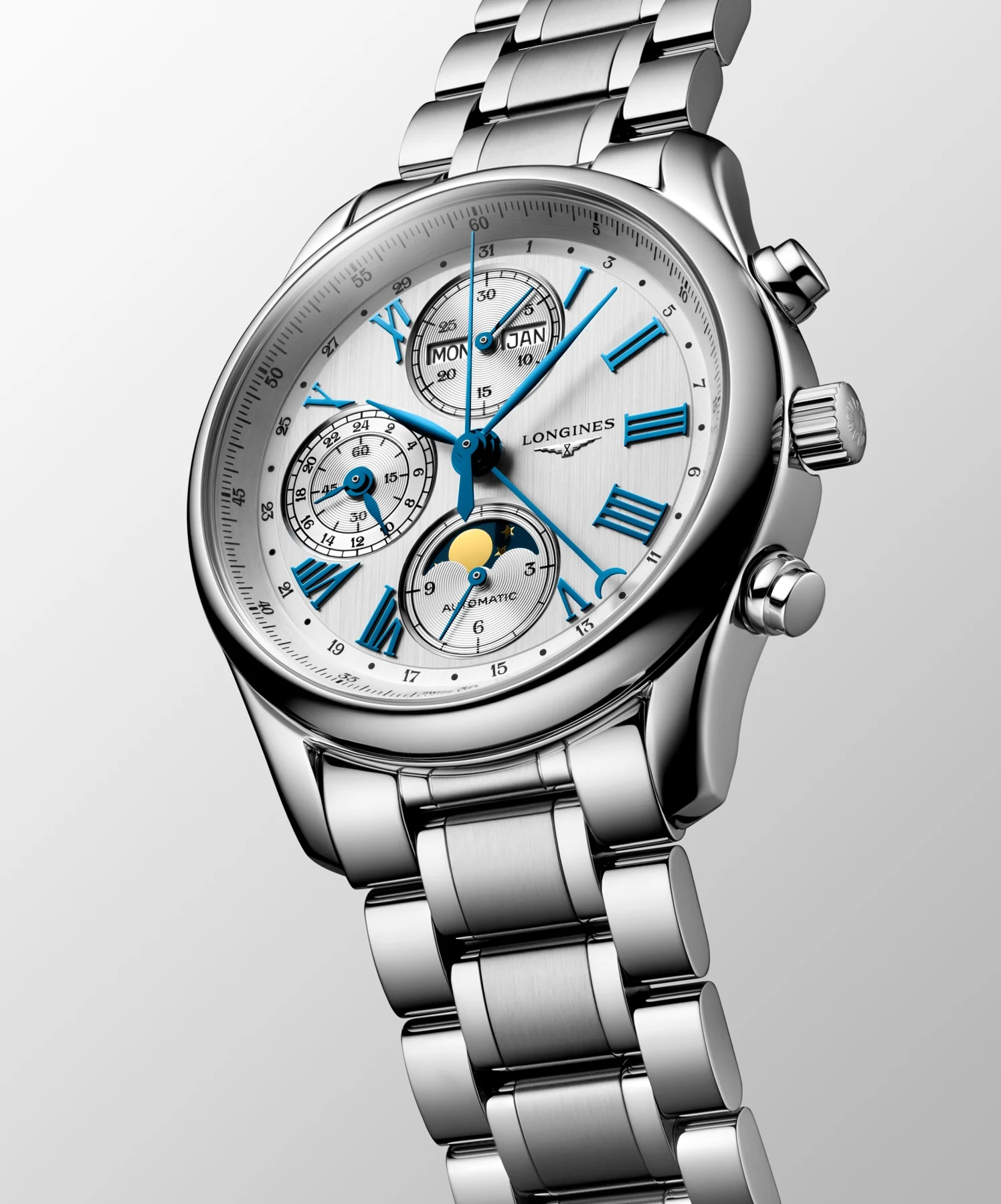
Longines Master Collection L2.673.4.71.6 on its steel bracelet, official three-quarter view

Watches / No. 03 / Longines

Longines Master Collection Chronograph Moon Phase

A 40mm automatic chronograph with day, date, month and moon phase, on a stainless-steel bracelet. Wind it, set it, wear it through the working week and straight into the evening.

L2.673.4.71.6 · Automatic · $4,150 USD
Photograph: Longines · Image source

Case40 mm
Lug width21 mm
Power reserveUp to 66 hours
Water resistance3 bar
01 / The watch

A calendar and a stopwatch on one dial.

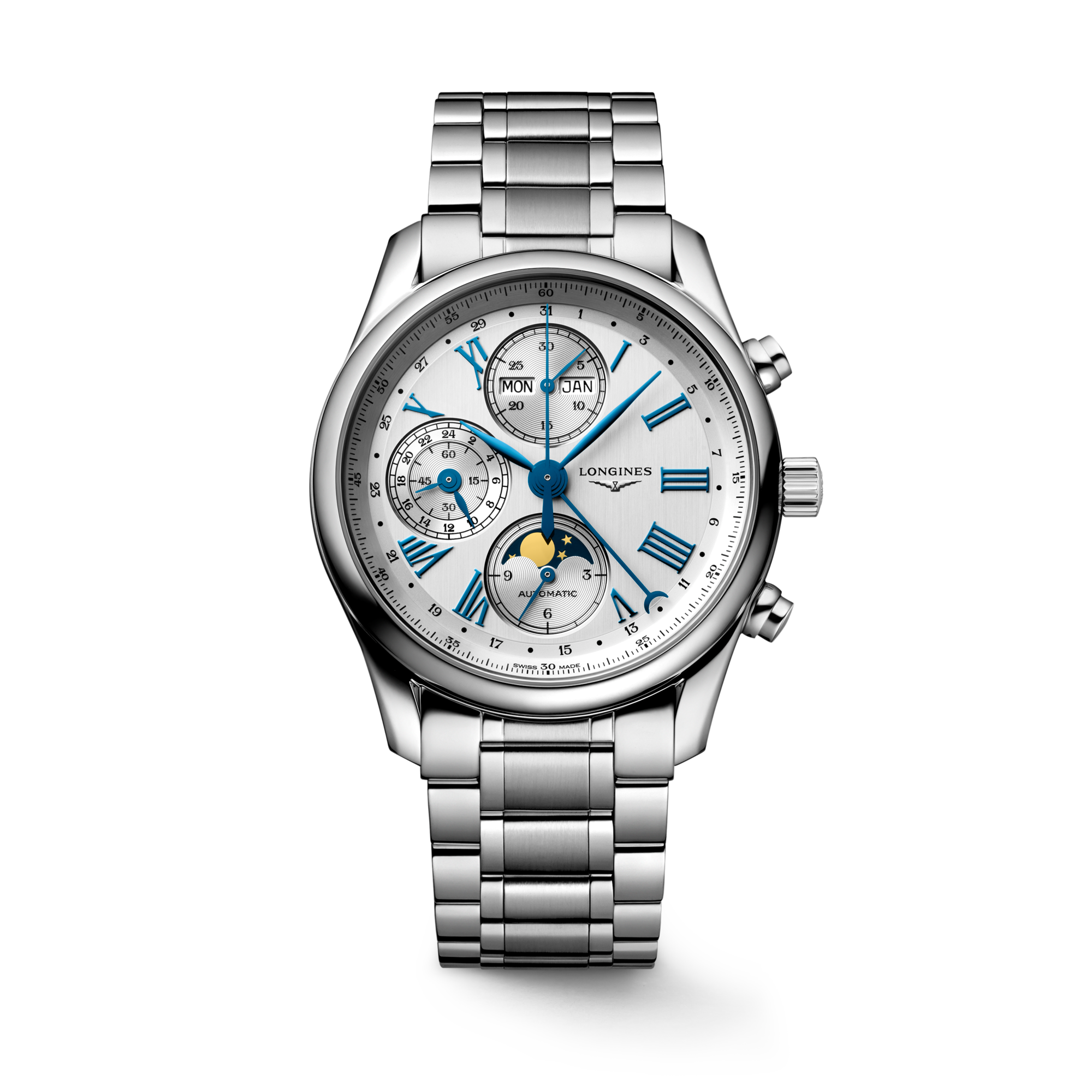
Start the chronograph for a task, check the calendar before a journey, glance at the moon on the way home. This dial has work to do between meetings, trains and late dinners. The moon sits inside the twelve-hour chronograph counter at six. Above it, day and month share the thirty-minute counter at twelve; a crescent-tipped central hand points to the date around the edge. Small seconds and a 24-hour indicator occupy the counter at nine.[1][2]

The reference here is L2.673.4.71.6, the 40mm stainless-steel bracelet model. It matches the reference attached to the retailer title “Chronograph Automatic Moon Phase Silver Dial Unisex Watch.” Longines currently calls this dial Opaline Ivory, with applied Roman numerals and blued steel hands. That is different from the collection’s silver “barleycorn” dial with Arabic numerals.[1][3]

Longines lists the current watch at $4,150 in the US, before tax. Its automatic, column-wheel chronograph movement is the L687.5, with a silicon balance spring and up to 66 hours of reserve. The case is 14.30mm thick, so the 40mm diameter does not tell the whole story of how it wears.[1]

The 24-hour subdial is an AM/PM indication of the displayed time, not an independently adjustable travel-time hand. The calendar is not annual or perpetual: the date needs correcting after months shorter than 31 days. If the movement runs down, the calendar and moon display will also need setting again.[2][4]
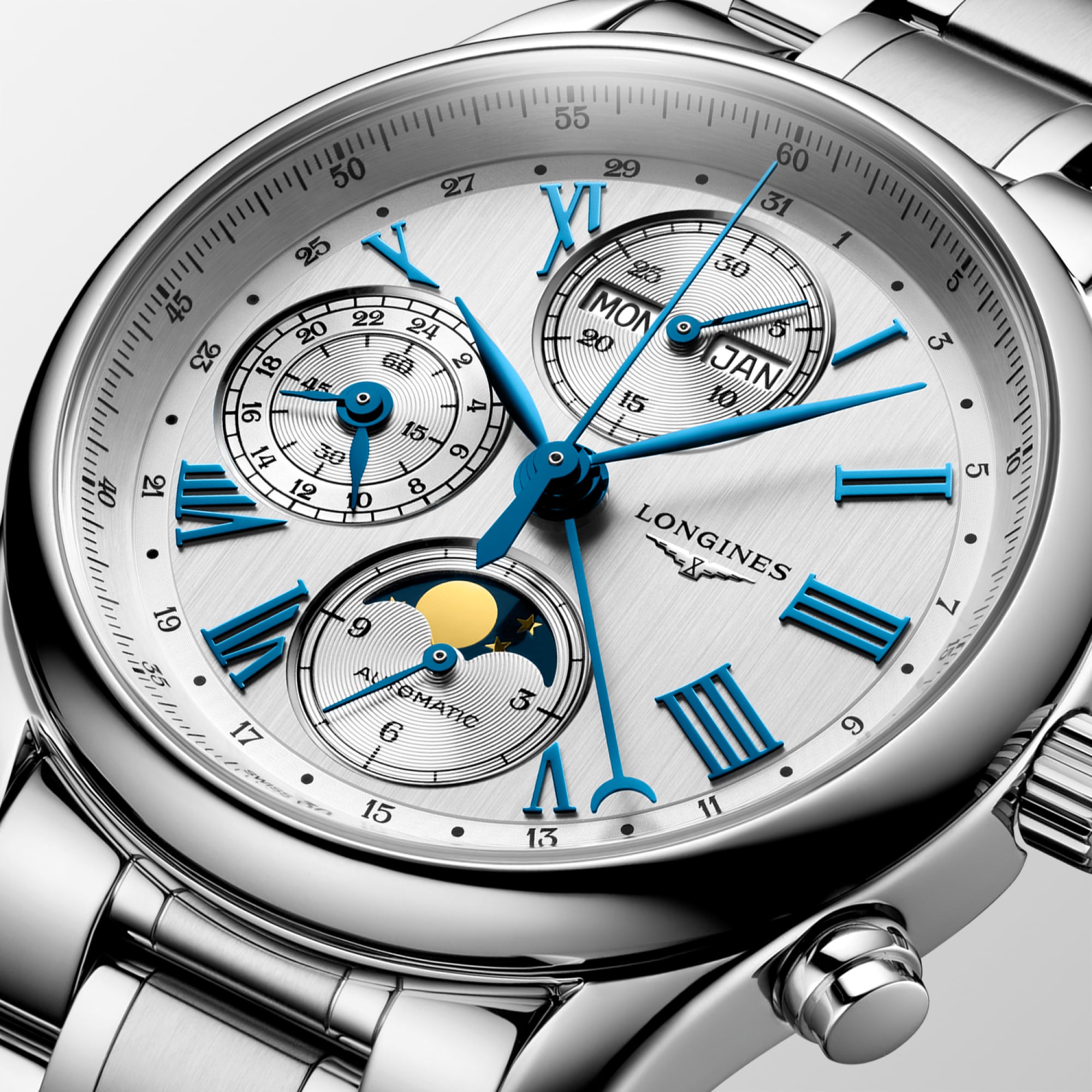
Close-up of the current Longines Roman-numeral dial, calendar windows and moon-phase counter
The current L2.673.4.71.6: applied Roman numerals, blued steel hands and the moon-phase aperture within the twelve-hour counter. Longines names the dial Opaline Ivory. Photograph: Longines. Source
02 / Watchmaking history

A modern collection with a long chronograph history.

Longines dates its first chronograph pocket-watch movement, the 20H, to 1878. In 1913 it introduced the compact 13.33Z wrist-chronograph calibre. The 13ZN followed in 1936, with a flyback mechanism whose patent had been filed in 1935. Flyback allows a running chronograph to reset and begin another timing sequence with a single press.[5]

Those are milestones in Longines’ chronograph development, not the specification of this Master Collection model. The L687.5 uses a conventional start, stop and reset sequence; it should not be operated as a flyback chronograph. Learn that sequence and use it, whether you are timing part of a workday or the minutes before departure. A dressy dial does not retire the stopwatch.[2]

The Master Collection arrived in 2005, entirely composed of mechanical watches. Its chronograph moon phase brings elapsed-time measurement together with a full calendar and a lunar display. Keep those functions in your daily routine: read the date at your desk, run the chronograph when there is something to time, and let the watch travel with you rather than waiting for a formal invitation. It belongs to that modern collection rather than being presented by Longines as a reissue of one named vintage reference.[5][4]

There is older Longines moon-phase chronograph history, too. Sotheby’s documented a reference 6574, circa 1985, with a gilt dial, an 18k yellow-gold case, manually wound calibre 502, date and moon phases. Its catalogue describes a thirty-minute counter and moon-phase display. That is an earlier combination of functions, not evidence that the current Master Collection descends directly from that reference.[6]

03 / Older Longines

Light dials, fine scales and separate counters.

These two historical Longines share visible details with the modern watch: a round metal case, a pale dial, fine timing scales and contrasting hands. Their counter layouts and numerals are different. Neither has a moon-phase display, and neither is identified here as the original of the current Master Collection.[5]

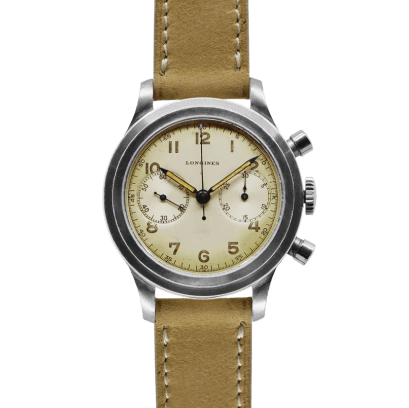
Historical Longines chronograph used to illustrate the 1936 calibre 13ZN milestone
Longines uses this historical chronograph to illustrate its 1936 calibre 13ZN milestone. The pale dial, two counters and fine outer scale offer a visual comparison; there is no moon-phase display. The timeline date identifies the movement milestone, not a documented manufacture date for this particular watch. Photograph: Longines. Source
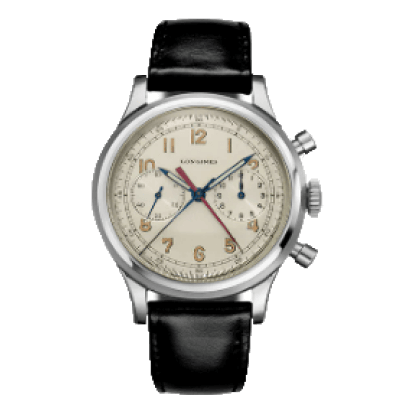
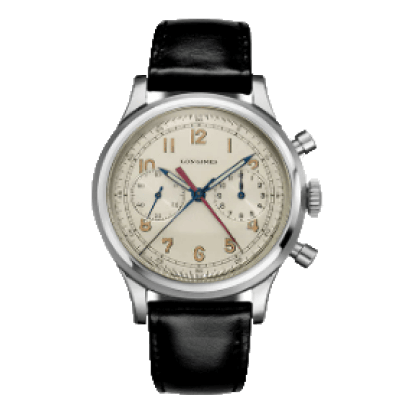
Historical Longines chronograph used to illustrate the 1942 calibre 13ZN12 milestone
Longines’ image for its 1942 calibre 13ZN12 milestone. Its large red central hand records elapsed minutes, while the right-hand counter records twelve hours. It shares a pale dial and blue hands with the modern watch, but not its calendar or moon phase. The date belongs to the timeline milestone. Photograph: Longines. Source

For a closer functional comparison, the 1980s reference 6574 adds the moon phase, but its gilt dial and gold case differ from the current steel watch. Sotheby’s illustrated catalogue entry identifies its photographed example and records its condition. It is a different object from the two Longines archive images above.[6]

The archive images are reproduced at their supplied resolution. Select either photograph to see the original PNG; neither has been enlarged to imply more detail.

04 / Proportions & mechanics

The current factory specification.

These measurements and movement details come from Longines’ current US product page, including its detailed specification fields. Older listings for the same reference may quote different dimensions or movement reserves; compare the particular watch and its documentation rather than combining specifications from different listings.[1]

L2.673.4.71.6Official front view of the current Longines L2.673.4.71.6 on steel braceletPhotograph: Longines. Source
L2.673.4.71.6 · Source: Longines · checked November 8, 2026
ReferenceL2.673.4.71.6
CaseRound stainless steel · 40.00 mm diameter
Thickness14.30 mm
Lug-to-lug46.70 mm
Lug width21 mm
Weight173.6 g, as published by Longines
CrystalScratch-resistant sapphire · anti-reflective coating on both sides
Case backTransparent · sapphire crystal
Water resistance3 bar / 30 m
Dial / handsOpaline Ivory · applied Roman numerals · blued steel hands
MovementL687.5 · automatic · column-wheel chronograph · monocrystalline silicon balance spring
Frequency28,800 vibrations per hour / 4 Hz
Power reserveUp to 66 hours
Time displayHours and minutes · small seconds and 24-hour indicator at nine
ChronographCentral 60-second hand · 30-minute counter at twelve · 12-hour counter at six
Calendar / moonCentral pointer date · day and month at twelve · moon phase at six
Factory braceletStainless steel · triple safety folding clasp · push-piece opening
US listed price$4,150, before tax
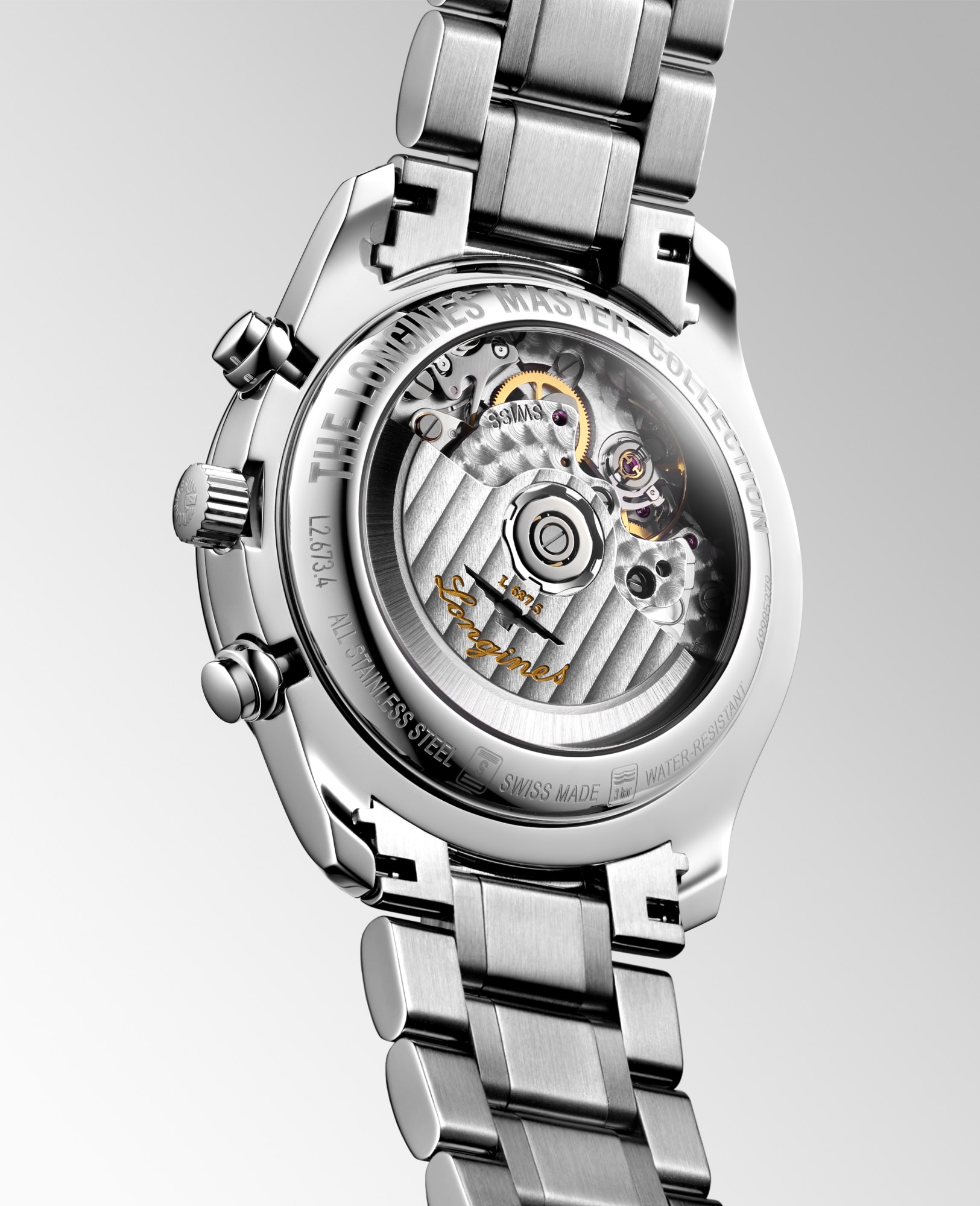
Transparent sapphire case back of the Longines Master Collection on steel bracelet
The sapphire case back reveals the automatic movement. The current product page identifies the calibre as L687.5. Photograph: Longines. Source
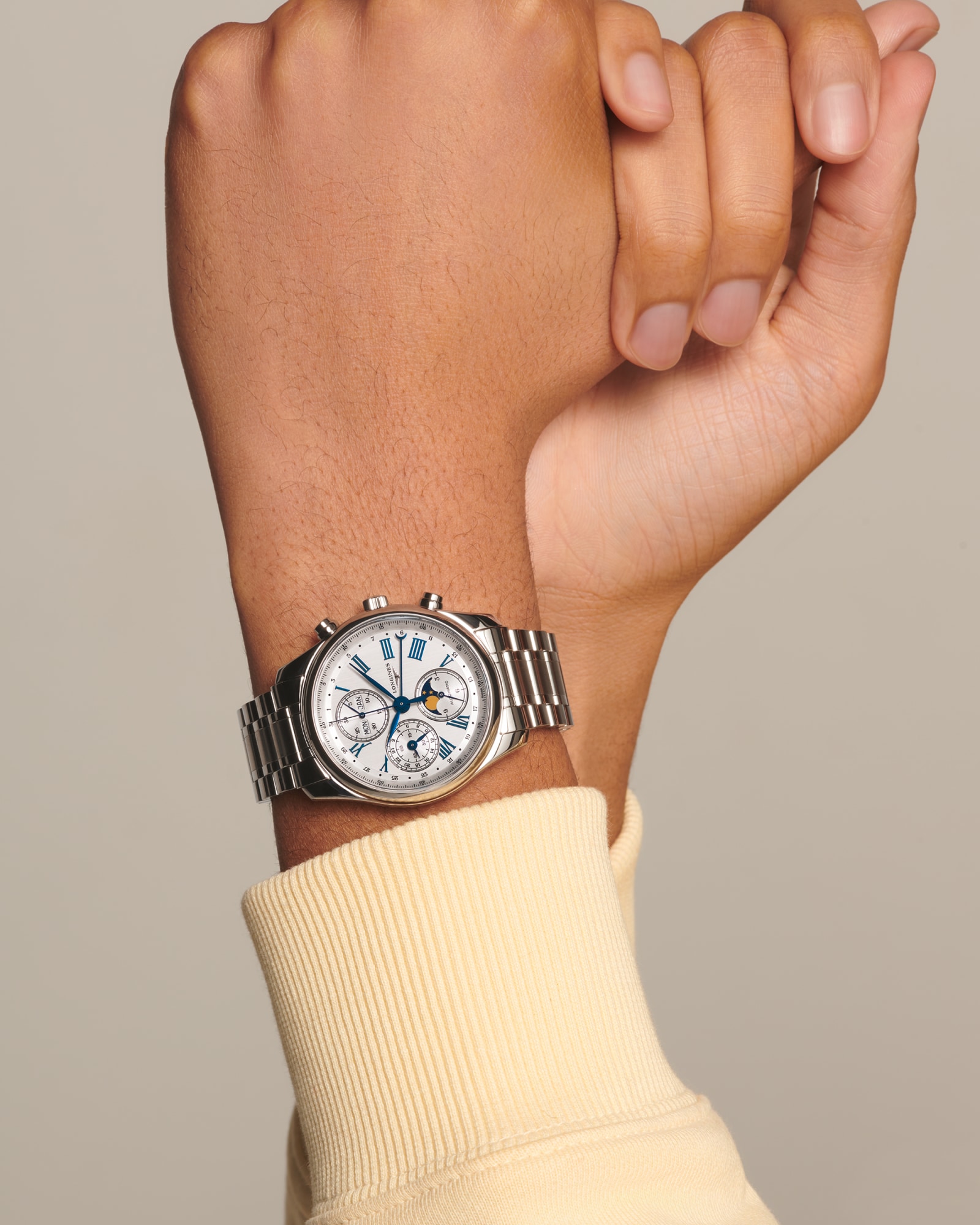
Current Longines Master Collection chronograph moon phase worn on a wrist
The 40mm model on its factory steel bracelet in Longines’ product photography. Wrist photographs show the watch in context, not a universal fit guarantee. Photograph: Longines. Source
05 / The Master Collection

The nearest alternatives.

L2.673.4.71.2 keeps the 40mm Opaline Ivory dial and adds a blue alligator strap in place of the bracelet. Longines lists it at $4,150, with the same advertised 66-hour reserve and 3-bar water resistance.[7]

L2.773.4.71.6 is the 42mm Opaline Ivory version on a steel bracelet, listed at $4,400. It retains the chronograph and moon phase, silicon balance spring and advertised reserve of up to 66 hours. It is a separate case size, not the 40mm watch under another retail description.[8]

For a dial Longines explicitly calls silver, L2.673.4.78.6 is the 40mm silver “barleycorn” bracelet model, at $4,100. The corresponding brown-alligator version is L2.673.4.78.3, also $4,100. Both have a textured dial with painted Arabic numerals rather than the applied Roman numerals of the watch shown here. Their individual specifications should be checked separately.[9][10]

Choose the version you can wear for a full day of work, travel and dinner, not just the one that photographs well. The choice is not just 40mm against 42mm: it is Roman against Arabic numerals, smooth against textured dial, and bracelet against leather. Size the bracelet for a wrist that moves all day. The shared Master Collection name does not make those references interchangeable.

06 / Straps & bracelet

Start with the 21mm lugs.

The current L2.673.4.71.6 is supplied on stainless steel, not leather. Longines specifies a triple safety folding clasp with push-piece opening and a 21mm distance between the lugs. A 22mm strap is not the correct nominal size for that published opening.[1]

For a replacement strap, width is only the first measurement. Confirm spring-bar diameter, clearance from the case, strap thickness and the intended buckle or clasp. Longines does not identify this bracelet as an interchangeable quick-release system on the current product page; do not assume tool-free removal or a universal end-link fit.[1]

If leather is the preference from the beginning, the factory blue-alligator L2.673.4.71.2 is the documented alternative. It has its own complete reference and folding clasp. Converting the bracelet watch is a separate fitting job; an official retailer can confirm the appropriate strap, bars and clasp parts.[7]

Wear it on the walk between appointments, through travel days and into the evening; a few incidental raindrops need not turn the day into a rescue mission. The water-resistance rating is 3 bar, far below a purpose-built dive watch: this is not the watch for swimming, diving or a soaking. Do not operate the chronograph pushers underwater. Follow the supplied manual for water exposure and calendar adjustment, and have the seals checked as recommended by Longines. Regular wear means respecting those limits, not leaving the watch unworn.[1][2]

07 / Finding the reference

Find the 40mm bracelet model.

The official product page is the clearest starting point for the current L2.673.4.71.6 and its factory specification. Check the complete reference, actual dial, included bracelet links and warranty terms before buying. For an older or pre-owned example, ask for photographs of the watch being sold, its service history and its movement documentation.

Longines / 40 mm

Master Collection Chronograph Moon Phase

L2.673.4.71.6
Current US listed price: $4,150, before tax.
Stainless steel bracelet · Opaline Ivory dial

Confirm availability and sizing with Longines or an official retailer.

A retailer’s “silver dial” title is not enough to distinguish this Roman-numeral reference from the silver barleycorn models. Match the complete reference and the seller’s photographs to the version you want. Then set the calendar, size the bracelet and put the chronograph into service. Desk marks and the wear of long days belong to a watch that goes places; water and hard-impact sport are jobs for something else.

Further reading

Sources & photography

Specifications and listed US prices checked November 8, 2026. Modern and historical photographs: Longines. Historical timeline dates refer to the movement milestones described by Longines, not independently established manufacture dates for the photographed objects. Select a photograph to open its source-size file. Historical images retain their supplied 409 × 408 pixel resolution.

  1. Longines — current L2.673.4.71.6 US product page: price, dial name, detailed case measurements, L687.5, movement functions, bracelet and official product photography.
  2. Longines — current English instructions for L687 / L687.5: display layout, chronograph operation and calendar adjustment.
  3. Jomashop — retailer title identifying the “Silver Dial Unisex Watch” as L2.673.4.71.6. Current factory specifications above are taken from Longines, not this retailer description.
  4. Longines — calendar types and the Master Collection chronograph with day, month and moon phase.
  5. Longines — official history: 1878 20H, 1913 13.33Z, 1936 13ZN, 1942 13ZN12 and 2005 Master Collection; source of the two historical watch images.
  6. Sotheby’s — Important Watches, 2019, lot 217: Longines reference 6574, circa 1985, gilt dial, calibre 502, date and moon phases. A separately documented historical watch, not a claim of direct model ancestry.
  7. Longines — 40mm L2.673.4.71.2, Opaline Ivory dial and blue alligator strap.
  8. Longines — 42mm L2.773.4.71.6 on steel bracelet.
  9. Longines — 40mm L2.673.4.78.6, silver barleycorn dial and steel bracelet.
  10. Longines — 40mm L2.673.4.78.3, silver barleycorn dial and brown alligator strap.

Hero and current watch photographs: Longines L2.673.4.71.6 product gallery. Historical images: 13ZN milestone photograph and 13ZN12 milestone photograph, from Longines’ official history.